CREATING A HEAVEN FOR THE ‘UNSUNG HEROES OF THE MOUNTAINS’...
32 ancient-era tombs discovered in Egypt’s Minya...
Mouse embryos grown in space for first time: Japan researchers...
Japan Moon lander revives after lunar night...
Russian editor’s Nobel Prize medal sold for USD 103.5 million,...
We will utilise this opportunity to smooth supply of fertilisers...
Departure in IT sector essential for national prosperity: Minister Sharma...
What are the rumors about Canada’s student immigration policy?...
Himlung Himal records season’s first summit of 7,000-metre peak...
63 mountaineers granted Mt Everest spring climbing permits...
Comprehensive evaluation of trade relations between Nepal and China
2024 April 01 Mon 9:45 pm
Share
The trade relations between Nepal and China have evolved significantly over the past few decades, reflecting the growing economic ties between the two nations. It is time to delve into a comprehensive evaluation of this crucial bilateral relationship, examining its historical roots, current dynamics, challenges, and opportunities that shape the future trajectory of this partnership.
The trade links between Nepal and China can be traced back to the ancient Silk Road, a network of trade routes that facilitated the exchange of goods, ideas, and cultural influences across vast distances. However, the modern era of trade relations witnessed a resurgence in the latter half of the 20th century, following the establishment of diplomatic ties in 1955.
The geopolitical significance of Nepal’s location, nestled between two Asian giants, China and India, has played a crucial role in shaping its foreign policy and economic relations. Historically, Nepal has maintained a balance in its ties with these two neighbours, recognising the potential benefits and challenges due to its strategic position.
In this context, strengthening trade relations with China has been viewed as an opportunity for Nepal to diversify its economic partnerships and reduce its over-reliance on a single trading partner. This diversification provides Nepal with greater economic leverage and aligns with its broader policy of maintaining a balanced foreign policy stance.
Political influence and high-level exchanges
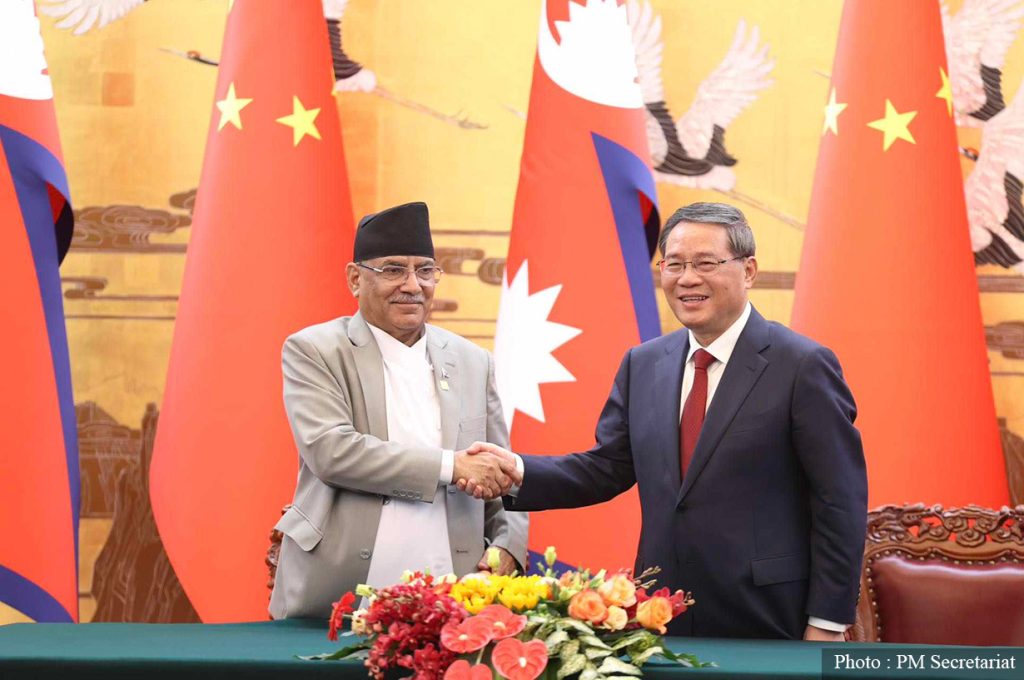
Prime Minister Pushpa Kamal Dahal and his Chinese counterpart Li Qiang. Photo: PM Secretariat
The political landscape has been a significant driving force behind the evolution of Nepal-China trade relations. High-level political visits and exchanges have played a pivotal role in fostering closer economic ties and paving the way for increased trade opportunities.
Notable visits by Chinese leaders, such as Zhou Enlai and Deng Xiaoping, to Nepal in the latter half of the 20th century, strengthened political ties and opened new avenues for economic cooperation. Reciprocal visits by Nepali leaders to China further solidified this partnership and demonstrated the commitment of both nations to deepen their bilateral relations.
It is worth noting that Nepal has undergone significant political transformations, transitioning from an absolute monarchy to a constitutional monarchy and eventually a republic. Despite these changes, trade relations with China have remained resilient, reflecting the pragmatic approach adopted by both countries in pursuing their economic interests while respecting each other’s political systems.
Trade dynamics and statistics
Over the past decades, the trade volume between Nepal and China has experienced a steady rise, reflecting the growing economic engagement between the two nations. China has emerged as Nepal’s second-largest trading partner, surpassed only by India, Nepal’s traditional and geographically proximate trade partner.
According to statistics from the Ministry of Commerce of the People’s Republic of China, the bilateral trade volume between Nepal and China reached $1.24 billion in 2020, with Nepal’s imports from China accounting for a staggering $1.19 billion, while exports to China were valued at a modest $49 million.
This trade imbalance, heavily skewed in favour of China, has been a point of concern for Nepal, as it contributes to a widening trade deficit and potential economic vulnerabilities. However, it is important to note that this trade pattern is not unique to Nepal, as many developing countries often face similar challenges in their trade relations with economic powerhouses like China.
Nepal’s imports from China
Nepal’s imports from China are diverse, encompassing a wide range of products spanning various sectors. Some of the major import categories include:
Machinery and electronics: Nepal relies heavily on imports of machinery, equipment, and electronic goods from China to meet the demands of its industrial and consumer sectors.
Textiles and garments: Chinese textiles and garments have flooded the Nepali market, catering to the demand for affordable clothing and apparel.
Plastic products: Nepal imports a significant amount of plastic products, ranging from household items to industrial components, from China.
Iron and steel products: Construction and infrastructure projects in Nepal have driven the demand for iron and steel imports from China.
Footwear: Chinese footwear, known for its affordability and variety, has gained significant popularity in the Nepali market.
Toys and games: Chinese-made toys and games have found a ready market in Nepal, catering to the demands of children and families.
China’s ability to produce goods at competitive prices has been a major factor driving Nepal’s imports from the Asian economic powerhouse. The appeal of Chinese products lies in their affordability, which caters to the purchasing power of Nepali consumers, particularly those from lower and middle-income segments.
However, concerns have been raised regarding the quality of some Chinese products imported into Nepal. The lack of warranty or guarantee for certain goods has been a point of contention, as it raises questions about product durability and consumer protection.
Addressing these quality concerns through robust quality control measures and regulatory frameworks could enhance consumer confidence and foster a more sustainable trade relationship.
Nepal’s exports to China
While Nepal’s imports from China have surged, its exports to the Chinese market have remained modest in comparison. Nonetheless, several key export items have found a foothold in the vast Chinese market:
Agricultural products: Nepal has been exporting agricultural commodities such as lentils, ginger, and cardamom to China, leveraging its comparative advantage in these sectors.
Handicrafts: Nepali handicrafts, renowned for their intricate designs and skilled craftsmanship, have found a niche market in China, appealing to consumers seeking unique and exotic products.
Textile products: Nepal’s textile industry has been gradually expanding its exports to China, capitalising on the growing demand for apparel and textile products.
Carpets: Nepali hand-knotted carpets, known for their quality and traditional designs, have gained popularity among Chinese consumers, particularly in the luxury market segment.
Herbs and spices: Nepal’s diverse array of herbs and spices, such as timur (Nepali pepper), has found a market in China, catering to the growing demand for exotic culinary ingredients.
While these export items have contributed to Nepal’s trade with China, the country faces several challenges in accessing the vast Chinese market. Limited production capacity, stringent quality standards, and logistical constraints have hindered Nepali exporters from fully capitalising on the opportunities presented by the Chinese market.
Addressing these challenges through investments in infrastructure, technological upgrades, and capacity-building initiatives could unlock the potential for Nepal to diversify its export basket and reduce the trade imbalance with China.
Investment and development cooperation
In addition to trade, China has emerged as a significant investor and development partner for Nepal. The Belt and Road Initiative (BRI), China’s ambitious global infrastructure development strategy, has opened new avenues for cooperation between the two countries. Chinese investments have been directed towards various sectors, including hydropower, transportation, and telecommunications. Notable projects include:
Pokhara Regional International Airport: This flagship project, funded by China, aims to enhance Nepal’s air connectivity and boost tourism.
Kodari Highway: This vital transportation link, connecting Nepal with China, is being reconstructed with Chinese assistance, facilitating cross-border trade and movement.
Hydropower Projects: Chinese companies have invested in several hydropower projects along Nepal’s Himalayan rivers, helping to address the country’s energy needs and harness its vast hydropower potential.
These investments contribute to Nepal’s infrastructure development and strengthen the economic ties between the two nations. However, concerns have been raised about the potential debt burden associated with some of these projects, highlighting the need for prudent financial management and careful consideration of the long-term implications.
Challenges and opportunities
While the trade relations between Nepal and China have flourished, several challenges need to be addressed to ensure a sustainable and mutually beneficial partnership:
Trade deficit: Nepal faces a significant trade deficit with China, which has implications for its overall trade balance and economic stability. Addressing this imbalance through export promotion, diversification of export products, and enhancing domestic production capabilities should be a priority.
Quality concerns: The quality of some Chinese products imported into Nepal has raised concerns, highlighting the need for robust quality control measures, consumer protection laws, and adherence to international standards.
Market access: Nepali exporters face challenges in accessing the vast Chinese market due to factors such as stringent standards, logistical barriers, and limited production capacity. Strengthening trade facilitation measures and capacity-building initiatives could improve market access for Nepali products.
Overdependence: There are concerns about Nepal’s increasing reliance on Chinese imports, which could potentially lead to economic vulnerabilities and dependency. Diversifying trade partnerships and strengthening domestic industries could mitigate these risks.
Environmental and Social Impact: Ensuring that large-scale infrastructure projects funded by Chinese investments adhere to environmental and social safeguards is crucial for sustainable development and minimising negative impacts on local communities.
Despite these challenges, the trade relations between Nepal and China present numerous opportunities:
Economic diversification: Strengthening trade ties with China can help Nepal diversify its economic partnerships, reducing over-reliance on a single trading partner and enhancing its bargaining power.
Infrastructure development: Chinese investments in infrastructure projects can support Nepal’s developmental goals, facilitate better connectivity, and improve trade logistics, thereby boosting economic growth.
Technology transfer: Collaboration with Chinese companies can facilitate the transfer of technology and expertise, enhancing Nepal’s industrial and manufacturing capabilities and fostering innovation.
Tourism promotion: With increasing Chinese tourist arrivals in Nepal, there is potential for promoting cultural exchange, boosting the tourism sector, and generating economic benefits for local communities.
Regional integration: Nepal’s strategic location and strengthened ties with China can position the country as a potential bridge between the two Asian giants, facilitating regional integration and economic cooperation.
The trade relations between Nepal and China have undergone a remarkable transformation, evolving from historical ties to a modern economic partnership with far-reaching implications. While the trade imbalance and concerns over product quality remain significant challenges, the opportunities for mutual growth and development are abundant. To harness the full potential of this bilateral trade relationship, both countries should prioritise addressing existing challenges through policy reforms, quality control measures, and capacity-building initiatives.
Nepal should focus on diversifying its export basket, enhancing market access in China, and strengthening its domestic industries to reduce the trade deficit. China, on the other hand, should continue to invest in Nepal’s infrastructure development and facilitate technology transfer, while ensuring that its investments adhere to environmental and social safeguards.
Additionally, promoting greater people-to-people exchanges and cultural understanding could foster a deeper appreciation for each other’s traditions and foster stronger ties between the two nations. Ultimately, a balanced and mutually beneficial trade relationship between Nepal and China can contribute to economic growth, infrastructure development, and improved living standards for the people of both nations, fostering a stronger and more sustainable partnership for the future.
By addressing the challenges and capitalising on the opportunities, Nepal and China can forge a path towards greater economic cooperation and regional integration, setting an example for South-South cooperation and mutual prosperity.